The method
Start with chords. Play along with real recordings. Read later.
This is how songwriters write and how bands learn. It is also the fastest way for an adult to play something they recognize, and to keep going.
01
Start with chords, not with reading notes
Four chords, C, G, Am and F, sit under hundreds of pop, rock and soul songs. In your first lesson you learn those four shapes with your right hand and one note for each with your left. That is enough to play a verse. Everything after that adds one new shape at a time, always inside a song you want to play.
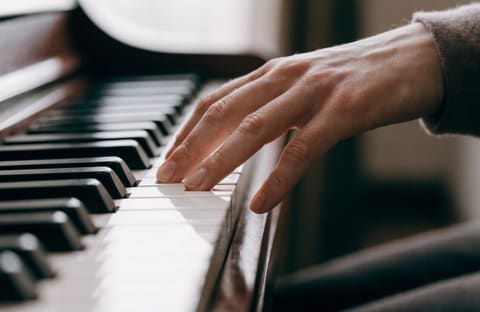
Thumb, middle finger, little finger.
The thumb slips down one key to B.
The sad one. Thumb back on C.
Thumb still on C. Four chords, done.
02
Play along with the real recordings
Not a simplified arrangement from a method book. The original track, in its original key, slowed down at first and then at full speed. Playing with a record teaches time, feel and confidence in a way that counting out loud never does. It is also a lot more fun.
03
Reading follows playing
Once your hands know the chords, notation stops being a wall of dots and becomes a map of something you already play. Each step is attached to a song you are already working on.
What reading looks like, in order
- 1
From day one: chord charts. C, G, Am, F over the bars.
- 2
By mid-year: lead sheets. The melody on a staff, the chords above.
- 3
In the second half: notes on the staff, for both hands.
04
Three threads, every month
Each month weaves the same three things together, so nothing is learned in the abstract.
Play
A new skill
One new chord, pattern or key, with the technique to play it comfortably.
The song
The song of the month
One famous song, start to finish, chosen because it needs exactly that skill.
Ear and reading
Hear it, then read it
Hearing what is happening in the song, and reading it on the page.
05
The monthly rhythm
Every song takes a month, and every month has the same four lessons. You always know where you are.
Week 1
Learn it
The new skill. We listen to the song together, read its chord chart and play the chords slowly.
Week 2
Build it
Skill drills, then the verse of the song with the track slowed down.
Week 3
Shape it
The chorus or the bridge, the month's ear and reading work, and a duet with me on the full song.
Week 4
Perform it
The whole song with the original recording, filmed on your phone, at home. Then a first listen to next month's song.
06
Why in person beats an app
Apps are good at showing you which key to press. They cannot see your hands, hear your room, or play with you.
Book a first visitLive correction of hands and posture
Tension and bad habits are easiest to fix in the first weeks, and only a person in the room can see them.
I play duets with you
You hold the chords and I play the melody, from the first lesson. Playing with someone is how time and feel get learned.
Your own instrument gets checked
Sticky keys, a bench at the wrong height, a pedal that does not work: I look at all of it on the first visit.
The songs are adjusted to your taste
The twelve songs are a starting list. If you dislike one, we swap it for another that teaches the same skill.
A fixed twelve-month path
One song a month, a concert every quarter and a recital at the end. You do not drift through levels on your own.
A practice plan fitted to your week
Fifteen minutes a day, written down at the end of every lesson, for the week you actually have.